
(Even When It Makes Sense)
5G Neutral host sounds like a no-brainer — One shared indoor network. Multiple operators. Better coverage for everyone.
Yet in deal after deal, mobile network operators (MNOs) hesitate… or quietly walk away.
If the economics look good and the technology exists, what’s really blocking adoption?
Neutral host: Is it a win–win?
In theory, the story is simple:
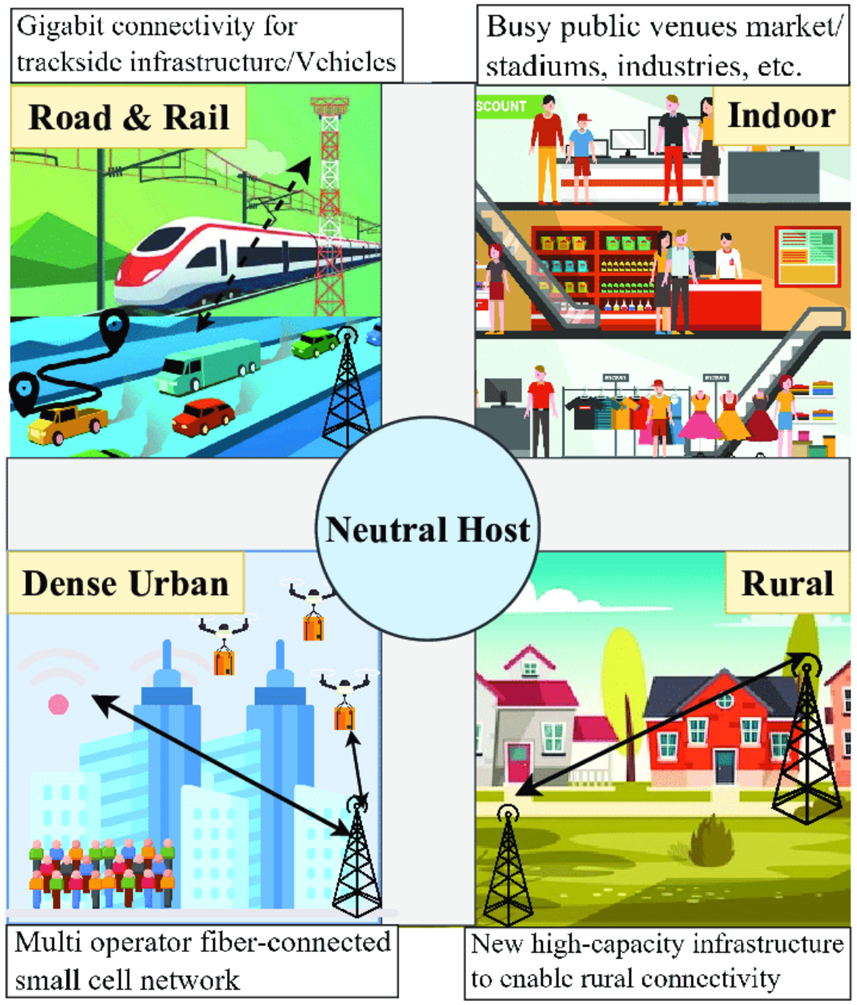
- A building owner (or neutral host provider) funds a shared indoor network.
- Multiple MNOs plug in and offer 4G/5G service over the same infrastructure.
- Users get full bars indoors.
- Operators avoid heavy in-building CAPEX.
- The venue increases its value and tenant satisfaction.
But if you talk to people inside operators – strategy, architecture, radio planning, or core engineering – you’ll hear a different story:
“MNOs like the concept. But integration with a neutral host is painful and risky.”
Let’s unpack why:
1. Control and brand risk: “If it breaks, our logo is on the phone”
For an operator, RAN quality = brand.
- Dropped calls
- Poor throughput
- Failed handovers
- Delayed emergency calls
…all show up to the user as: — “My operator is bad here.” Vs WiFi poor coverage / no coverage is not an Operator issue.
With neutral host, the radio is no longer fully under the operator’s control:
- Someone else decides antenna placement, power, and optimization.
- Someone else schedules maintenance, changes software, and troubleshoots hardware.
- Someone else may be tuning RF parameters that affect your mobility KPIs.
If that building has chronic issues, the customer doesn’t complain to “the neutral host.”
They complain about the operator whose PLMN is on the screen.
From a brand and NPS perspective, that’s scary.
2. Operational complexity: “We don’t need another pseudo-vendor”
To support a neutral host technically, the MNO usually has to:
- Integrate core interfaces (N2/N3, sometimes S1 for legacy).
- Align feature sets (VoLTE/VoNR, carrier aggregation, DSS, 5G SA options, emergency call flows).
- Secure connectivity (IPsec, certificates, routing policies, firewalls).
- Add monitoring, alarms, and incident workflows into OSS / NOC.
- Coordinate software upgrades and regression testing.
Even if the neutral host is “one company,” operationally it behaves like another RAN vendor:
- Another way to break things.
- Another set of software releases to validate.
- Another domain to pull into root cause analysis when KPIs drop.
When you already have 2–3 major RAN vendors plus small cells, Wi-Fi, and private 5G projects, the default reaction inside an operator is:
“Do we really want to own one more integration and support model?”
Often, the answer is no – even if the venue is attractive.
3. Regulatory and liability concerns: “Who is accountable when things go wrong?”
Mobile networks are not just about data throughput.
Operators are on the hook for:
- Emergency services (E911/112), including accurate location.
- Lawful intercept and security.
- National regulations around public warning systems and priority communications.
When traffic originates from a third-party RAN:
- Is emergency location still accurate?
- Does any added latency or packet handling affect call setup or quality?
- Are there any gaps in logging, traceability, or intercept compliance?
Compliance and security teams tend to be conservative. If they can’t get clear guarantees, their default position is:
“We would rather not depend on 3rd-party radios for regulated services.”
This doesn’t mean neutral host is impossible; it means the bar is high and the burden of proof is on the neutral host provider.
4. Economics: “Where’s the upside on our P&L ?”
From the operator CFO’s perspective, indoor neutral host must compete with other investments:
- Macro coverage and capacity.
- Spectrum acquisition and refarming.
- Core modernization, IT transformation, new B2B products.
In many markets:
- In-building traffic is a fraction of total usage.
- Many buildings already have “good enough” macro + Wi-Fi from the user’s viewpoint.
- Revenue uplift from “better indoor 5G” is hard to isolate and prove.
So the question becomes:
“Should we spend scarce integration and operational budget on this neutral host,
or on something with clearer, network-wide ROI?”
If the answer is fuzzy, neutral host doesn’t make the cut – even if the venue is cool and the tech is elegant.
5. Competitive strategy: “Are we helping our rivals too?”
Neutral host by design is multi-operator:
- Once Operator A integrates, it’s easier for Operator B and C to join the same platform.
- The playing field inside that building flattens.
For some operators, especially those with a stronger macro presence or an existing single-operator indoor system, the question is:
“Why should we help create a shared platform that also benefits our competitors?”
They may prefer:
- Exclusive or quasi-exclusive in-building systems, or
- Simply letting the venue and users rely on Wi-Fi and macro, even if imperfect.
Again, this isn’t about technical feasibility; it’s about competitive positioning.
6. Organizational mindset: “Whose problem is indoor coverage, anyway?”
There’s also a softer but very real factor: ownership inside the operator.
- Radio planning teams focus on macro coverage and regulatory obligations.
- Enterprise / B2B teams care about large accounts, but don’t always control RAN decisions.
- Consumer marketing is measured on NPS and churn, but doesn’t run network integration.
Neutral host cuts across all of these:
- It’s part RAN, part B2B, part strategy, part finance.
- If no single team “owns” the problem, it’s easy for indoor neutral host to die in meetings.
In the end, “do nothing” often wins for MNOs by default:
Macro is fine. Wi-Fi works “most of the time.” Complaints are noisy but not always quantified. Let’s focus on the next 5G spectrum or core upgrade instead.
So… are operators being irrational? – Not really.
When you look from the inside out, MNO hesitation is rational:
- They risk their brand on someone else’s radio quality.
- They take on a new integration + operational burden.
- They face regulatory and liability questions.
- The economic upside is not always obvious.
- And they might even help their competitors.
- Understanding this is important if you’re:
- A neutral host / DAS / small-cell provider,
- A building owner or enterprise IT team, or
- An investor looking at shared infrastructure.
You can’t just sell neutral host as “DAS, but shared” or “cheaper indoor.”
You have to address operator fears head-on.
What would make MNOs say “yes” more often?
From my conversations and experience, a more operator-friendly neutral host model would:
- Feel more like roaming than like adding a new RAN vendor.
- Keep policy, security, and regulated functions anchored in the MNO core.
- Give operators clear visibility and control:
- KPIs per site
- Ability to enable/disable PLMN per venue
- Predictable SLAs and escalation paths
- Offer simple, repeatable commercial templates that line up with how operators budget.
In other words: lower integration friction, clearer control boundaries, and a business model that doesn’t require a special internal battle every time a building wants indoor coverage.
That’s where I believe the next generation of neutral host needs to go.
What I’m working on (and looking for)
This article is Part 2 of my series on in-building coverage and neutral host:
- Why in-building coverage is still broken in the 5G era
- Why MNOs don’t embrace neutral host (even when it makes sense) 👈 this post
- The indoor coverage stalemate and how everyone loses
- Reimagining neutral host: a lightweight, roaming-like on-ramp for MNOs
I’m working on a patent-pending neutral host architecture designed specifically to:
- Let neutral hosts plug into MNOs in a much lighter, roaming-like way, and
- Preserve strong operator control and compliance, while lowering the barrier to indoor sharing.
In the next article, I’ll talk about the stalemate this current friction creates for operators, building owners, and users – and why doing nothing is becoming more expensive for everyone.
I’d love your perspective
If you:
- Work in an operator on RAN / core / strategy / enterprise,
- Run or build for a neutral host / DAS / small-cell company, or
- Own or manage buildings where indoor connectivity is a constant pain point,
…I’d really like to hear what you’re seeing.
Question for you:
👉 When your organization looked at neutral host, what was the real blocker – control, integration, regulation, economics, or internal politics?
Drop a comment, or DM me if you’d like to compare notes. I’m building a small circle of people who want to rethink neutral host in an operator-friendly way.
Suggested hashtags:
#5G #NeutralHost #Telecom #InBuildingCoverage #NetworkSharing #OpenRAN