

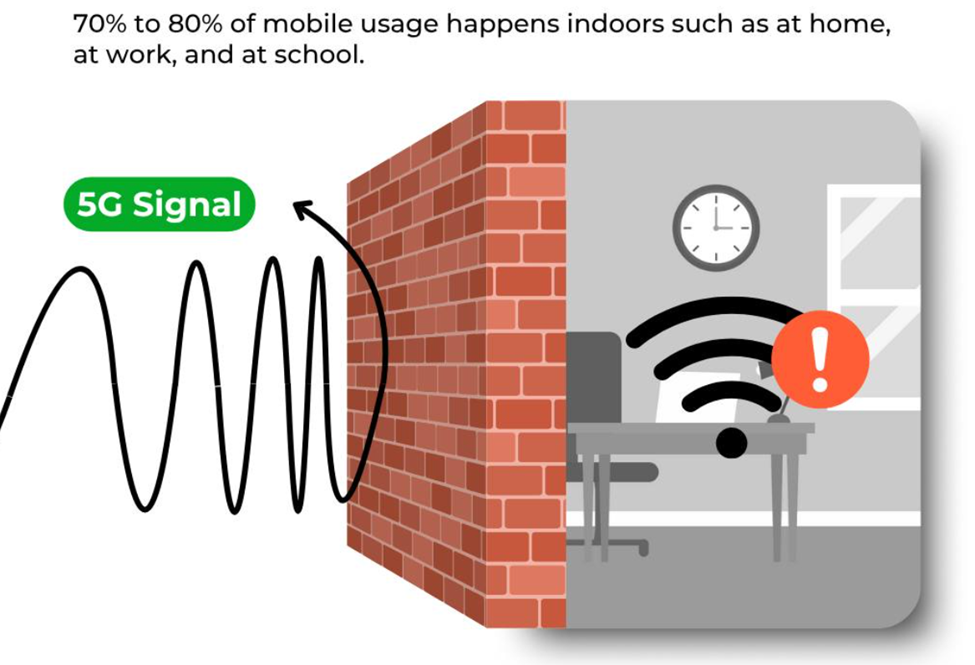
We live in a 5G world, but step into an office, hospital, mall, or parking garage… and suddenly it’s 2 bars, 1 Mbps, or “No Service.”
At the same time, every mobile operator tells us they’re investing billions in 5G.
So why is in-building coverage still so bad?
The paradox: 5G outside, dead zones inside
From the street, coverage is usually fine. Inside buildings – where people actually work, shop, and live – it often collapses.
This isn’t just a “user annoyance” problem:
- Sales teams can’t complete mobile checkouts.
- Doctors and nurses lose connectivity deep inside hospitals.
- Tenants complain about calls dropping in their own living rooms.
- Enterprises spend money building Wi-Fi workarounds instead of getting reliable cellular.
We’ve had DAS, small cells, Wi-Fi offload, CBRS, and now 5G. Yet the experience inside many buildings hasn’t caught up. Something structural is broken.
Why Wi-Fi offload didn’t solve it
“Isn’t Wi-Fi the answer?” Partially – but not really. Wi-Fi is great for best-effort data, but:
- It’s not consistently engineered like a carrier-grade cellular network.
- Roaming between Wi-Fi and macro is clunky.
- Voice, emergency services, and mobility are still anchored in the cellular world.
- When Wi-Fi is bad, users don’t care whether it’s “Wi-Fi’s fault” or “the operator’s fault” – they just experience bad connectivity.
Wi-Fi offload helped reduce macro congestion, but it didn’t fix the indoor mobility & reliability gap.
Why operators don’t just build indoor systems everywhere
On paper the answer is simple: “Let the mobile operator build in-building systems (DAS, small cells, 5G indoors).”
In practice, that hits several walls:
- 📍 Cost vs. revenue: Many buildings are not “big enough” in ARPU terms to justify a dedicated in-building deployment per operator.
- 🏢 Multiple operators: A landlord doesn’t want 3 or 4 separate systems cluttering risers and ceilings.
- 🧩 Complex deployment: RF design, permits, landlord coordination, construction access — all of this is slow and painful.
- 🧾 Budget priorities: Operators prioritize macro, 5G spectrum, and national coverage stats. A single office building struggles to compete for budget against all of that.
So operators often conclude:
“Macro + a bit of Wi-Fi is good enough for now.” If you’re a building owner or enterprise IT lead, you know it often isn’t.
Neutral host: great concept, limited adoption
This is where neutral host should shine:
- One shared in-building network.
- Multiple operators can ride on top.
- The building funds the infrastructure once; all MNOs benefit.
In theory, everyone wins:
- Users get reliable, indoor 4G/5G.
- Operators improve experience without heavy CAPEX.
- Landlords increase property value and tenant satisfaction.
So why isn’t this the default for most buildings?
Because in practice, many MNOs hesitate to connect to neutral hosts:
- They worry about losing control over RAN quality, optimization, and KPIs.
- They’re nervous about regulatory and liability implications (E911, lawful intercept, etc.).
- They don’t want to add yet another complex vendor / integration to their already crowded network stack.
- And the economics and commercial models are still not standardized or operator-friendly.
The result:
Operators often don’t want to pay for indoor, and don’t fully trust neutral host either. That’s the stalemate.
Who loses in this stalemate?
Everyone:
- End-users: Calls drop, apps stall, and the “5G” in the status bar feels like a lie.
- Landlords & enterprises: They get constant complaints and are forced into DIY Wi-Fi patches and boosters.
- Operators: They see churn, negative NPS, and missed enterprise opportunities — but the problem is “hidden” inside buildings.
We have the technology — small cells, neutral host, shared spectrum, Open RAN, even 5G SA. What’s missing is a model that aligns incentives and reduces friction for operators to actually connect.
Where I’m going with this series
Mobilestack is working on developing this new RAN-sharing model which reduces friction and allows operator traffic on indoor NEUTRAL-HOST network as per operator’s operational requirements which can be turned-on / off as per operator performance KPIs. This post is Part 1 of a short series on why in-building coverage is still broken and how we can fix it:
- Why in-building coverage is still broken in the 5G era 👈 this post
- Why MNOs don’t embrace neutral host (even when it makes sense)
- The indoor coverage stalemate and how it hurts operators, owners, and users
- A new way to connect neutral hosts to operators – lightweight, roaming-like, and operator-friendly
Mobilestack is working on a patent-pending neutral host architecture that aims to:
- Let neutral host infrastructure plug into operators in a much lighter way (more like roaming, less like a full RAN vendor integration).
- Give operators strong control & visibility without heavy CAPEX.
- Make it easier for building owners to get real indoor coverage instead of patchwork solutions.
If you’re:
✅ Working on neutral host / DAS / small cells / Open RAN
✅ Involved in operator strategy, enterprise mobility, or infra investment
✅ Or just frustrated with indoor coverage as a user or landlord
…I’d love to connect and compare notes.
Question for you:
👉 In your experience, what is the biggest blocker to better indoor coverage: technology, business model, or organizational mindset?
(Feel free to comment or DM – I’m building a small circle of people interested in solving this.)
Suggested hashtags:
#5G #NeutralHost #InBuildingCoverage #Telecom #OpenRAN #NetworkSharing #IndoorCoverage