
How Everyone Loses – Operators, Owners, and Users
Why Doing Nothing Is No Longer an Option
We’ve accepted a strange reality in mobile networks:
- Great coverage on the street.
- Unreliable coverage where people actually live, work, and spend money – inside buildings.
For years, the industry has treated indoor coverage as a “nice to have” or something Wi-Fi will magically solve.
But as 5G matures and new services depend on reliable, low-latency connectivity indoors, doing nothing is quietly becoming the most expensive strategy of all.
In this article, I’ll walk through how the indoor coverage gap hurts operators, building owners, and end-users – and why the future of network densification must include a small-cell / neutral-host partnership model. Macro alone will not carry us through the next five years.
1. The hidden gap in a “5G everywhere” world
Outdoor coverage has improved dramatically:
- Massive macro builds
- New mid-band spectrum
- 5G carrier aggregation and more sophisticated radios
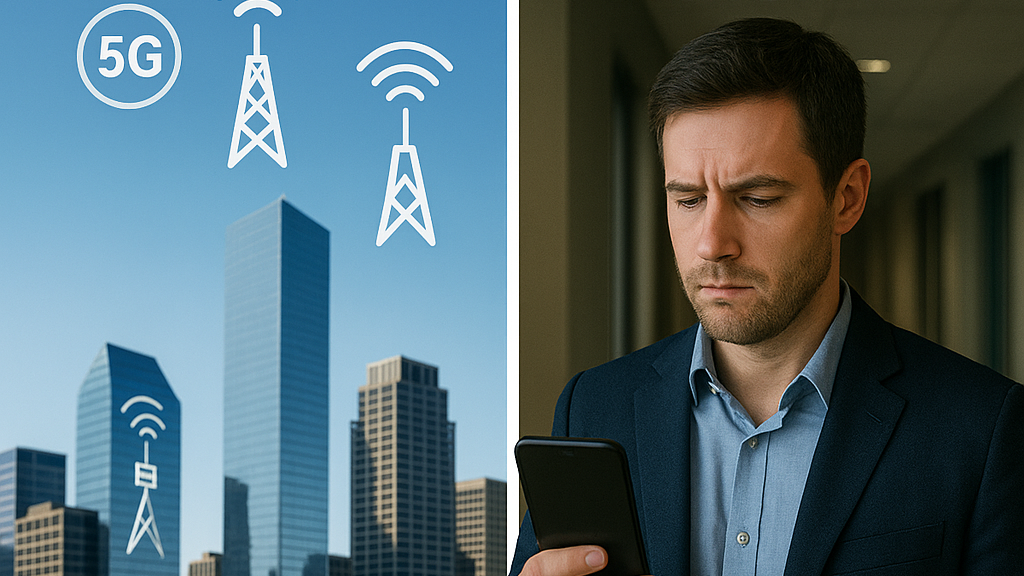
From the outside, the network looks great.
But step into an office tower, hospital, mall, underground parking, or even many apartments, and you’ll often see:
- 1–2 bars of signal
- Dropped voice calls
- Unstable data sessions
- Phones falling back to 4G or even 3G (where it still exists)
The paradox: our networks are getting faster, but they’re not getting much better where people actually use them most – indoors.
Why? Because walls, glass, metal, and energy-efficient materials are fantastic at blocking RF. And we’ve relied on a combination of:
- Macro “leaking in” through windows
- Patchwork Wi-Fi
- A few bespoke DAS / small-cell deployments for premium venues
That worked when mobile traffic was mostly best-effort data. It does not work well for:
- Real-time collaboration (video meetings)
- Telemedicine and hospital workflows
- Mission-critical enterprise apps
- Retail mobile POS
- IoT and automation in buildings and campuses
The indoor gap has become a business problem, not just a “coverage map” problem.
2. How operators lose by tolerating poor indoor coverage
From an operator’s perspective, it’s easy to say:
“We cover the area. If the building blocks the signal, that’s the landlord’s issue.”
In practice, customers don’t make that distinction. They see:
- “My phone doesn’t work in my office.”
- “I have no signal in my apartment.”
- “My calls drop in the hospital.”
And they blame the brand on the SIM, not the building.
2.1 Churn and NPS erosion
- Indoor experience is a top churn driver: when people can’t make calls at home or work, they change operators.
- Net Promoter Score (NPS) and app-store ratings for the operator’s apps take a hit.
- Brand promises like “5G Ultra” or “Best Network” sound hollow when reality indoors is 1 bar at 1 Mbps.
The irony: macro KPIs can look great, while silent churn is happening because of indoor frustration the dashboards don’t fully capture.
2.2 Lost enterprise and private 5G opportunities
Enterprises and landlords increasingly want:
- Reliable mobile connectivity as a basic utility, like power and water.
- Integrated mobility for their workers, guests, and devices.
When an operator can’t offer a compelling indoor solution, they:
- Lose opportunities to alternative providers, Wi-Fi-first players, or competitors willing to build.
- Miss the chance to bundle private 5G / small-cell offers into broader enterprise deals.
Indoor coverage is often the entry point for deeper enterprise relationships. Weak indoor strategy = weak enterprise strategy.
2.3 Rising network costs without proportional value
When indoor is bad, users:
- Force their devices onto macro where the signal barely penetrates, increasing retransmissions and drain on radio resources.
- Hammer Wi-Fi calling over unmanaged Wi-Fi networks, generating hard-to-debug support calls.
Operators end up:
- Spending on macro optimizations and troubleshooting that don’t fix the root indoor problem, and
- Burning OPEX to handle complaints and drive tests in buildings where they have no structured indoor strategy.
3. How building owners and enterprises lose
Building owners, property managers, and enterprise IT teams are also caught in the middle.
3.1 Tenant satisfaction and lease value
For residents and commercial tenants, “no signal indoors” is no longer acceptable:
- Apartment renters will choose another building where their phone works.
- Office tenants complain to property managers – or negotiate harder on rent and renewal.
- Retail tenants lose sales when mobile checkout stalls.
Poor indoor coverage quietly erodes:
- Rent premiums
- Occupancy rates
- Overall asset value
3.2 DIY patchwork solutions
In the absence of a clean operator / neutral-host model, owners and IT teams resort to:
- Consumer-grade boosters and repeaters.
- Overgrown Wi-Fi networks meant to carry everything (voice, data, IoT).
- Single-operator small-cell or DAS builds that don’t scale to all tenants’ carriers.
The result:
- RF interference and unpredictable performance.
- Complex support scenarios (“Is it the booster? Wi-Fi? ISP? Operator?”).
- No consistent SLA across operators.
It’s a technical debt bomb that only gets worse as needs grow.
3.3 Risk to business operations
In some venues, indoor coverage is more than convenience:
- Hospitals and clinics
- Warehouses, logistics centers, and factories
- Transportation hubs
Poor mobility can directly:
- Impact operations (e.g., nurses walking to windows for signal).
- Slow down deliveries and scanning workflows.
- Affect safety and emergency response.
For these cases, “we’ll see if macro is enough” is not a responsible long-term plan.
4. How end-users lose – and change their behavior
End-users – employees, residents, visitors, patients – feel the pain most directly:
- They walk around looking for a “signal corner.”
- They switch calls from mobile to desktop apps.
- They toggle airplane mode or disable 5G bands to get a stable connection.
Over time, they:
- Lose trust in their operator.
- Blame the building and management.
- Develop workarounds that dilute the value of true mobility.
When that user finally hits a breaking point, they:
- Switch operators, or
- Put pressure on landlords and IT to “fix the building.”
In other words, the cost of doing nothing eventually shows up as churn, complaints, and reputational damage.
5. The macro era is plateauing – densification must move indoors
For the last decade, network evolution has been driven by:
- New frequency bands
- More spectrum
- Taller macro sites and smarter antennas
That era is maturing:
- In many markets, macro site counts will not grow dramatically over the next 5 years – planning, zoning, and economics all push against it.
- Additional capacity from macros will be incremental, not transformational.
The next wave of performance and experience gains must come from densification and moving closer to the user, especially indoors:
- Small cells
- Indoor 5G systems
- CBRS / shared-spectrum deployments
- Neutral-host and multi-operator solutions
In other words, the future of wireless is less about more towers, and more about smarter, denser, indoor deployments.
6. Doing nothing is not a neutral choice
Given all this, “do nothing” is not really a neutral choice anymore. It has very clear consequences:
For operators
- Slow but steady churn driven by poor indoor experience.
- Missed enterprise and private 5G revenue.
- Rising OPEX to fight symptoms instead of the root cause.
- A widening gap between 5G marketing and real-world perception.
For building owners & enterprises
- Lower tenant satisfaction and weaker negotiating position on leases.
- Persistent IT headaches from fragmented Wi-Fi and booster workarounds.
- Operational risk in critical venues (healthcare, logistics, industrial).
For users
- Ongoing frustration and lost productivity.
- Split experience where “5G” is something they have outside, not where they spend most of their time.
The status quo is already costing everyone. As new applications (XR, real-time collaboration, automation) move from hype to reality, those costs will spike.
7. The path forward: small-cell & neutral-host partnerships
If macro is not going to grow much, and doing nothing is too expensive, what’s left?
A realistic indoor strategy for the next 5 years must include:
7.1 Small-cell centric densification
- Deploy low-power small cells where traffic and business value are concentrated: offices, campuses, malls, hospitals, warehouses.
- Use modern architectures (virtualized RAN, cloud-native control) to manage many small nodes efficiently.
- Integrate with shared or local spectrum where appropriate (CBRS, local licenses, etc.).
7.2 Partnership-based models, not operator-alone CAPEX
Operators can’t and won’t fund every building themselves. Instead:
- Neutral host providers or building owners invest in the physical layer.
- Operators connect via a standardized, low-friction interconnect (ideally more like roaming, less like “new RAN vendor”).
- Costs and responsibilities are shared in a structured way.
This kind of partnership turns indoor coverage from a case-by-case negotiation into a repeatable model.
7.3 Operator-friendly interconnect
To make operators comfortable, the next generation neutral-host model needs to:
- Preserve operator control over policy, security, and regulated functions.
- Provide clear visibility into KPIs and fault domains.
- Offer simple SLAs and commercial templates so every project doesn’t start from scratch.
That’s the direction I believe we need to move in as an industry.
8. What I’m working on – and who I’d like to connect with
This article is Part 3 of my series on in-building coverage and neutral host:
- Why In-Building Coverage Is Still Broken in the 5G Era
- Why MNOs Don’t Embrace Neutral Host (Even When It Makes Sense)
- The Indoor Coverage Problem: How Everyone Loses – Operators, Owners, and Users 👈 this post
- Reimagining Neutral Host: Removing friction-points of MNOs integration – keeping MNO in control for their customer’s experience (coming next)
I’m working on a patent-pending neutral host architecture designed to:
- Enable small-cell densification through a neutral host,
- Let MNOs plug in using a lightweight, roaming-like model, and
- Protect operator control while making it easier for buildings to finally get real indoor coverage, not just patches.
I’d love your input
If you’re:
- In an MNO looking at 5-year network densification strategy,
- Running or building a neutral host / DAS / small-cell business, or
- A building owner / enterprise IT leader struggling with indoor coverage,
…I’d love to compare notes and pressure-test ideas.
Question for you: 👉 In your world, what is the single biggest blocker to moving from “macro + Wi-Fi + hope” to a systematic indoor strategy: technology, business model, or internal alignment?
Drop a comment, or DM me if you’re interested in being part of a small group discussing practical, operator-friendly approaches to neutral host and small-cell partnerships.
Suggested hashtags: #5G #NeutralHost #SmallCells #InBuildingCoverage #Telecom #NetworkDensification #IndoorCoverage